Boneyard Reviews Part 5
Updated: Jun 23

Hard-Boiled Wonderland and The End of the World by Haruki Murakami
After reading Men Without Women, by Haruki Murakami, I did some research on him. I was intrigued enough with his writing style, I thought I’d give another one of his books a whirl.
I came across the books he’s really famous for, 1Q84, but oh my, it’s 1200 pages. I stated how I feel about a long book and 1200 pages is very scary, so I found a few small works, Kafa on the Shore and Hard-Boiled Wonderland and the End of the World might be a better place to start. Kafa on Shore didn’t seem a good fit right now, so I settled for The End of the World. (I never did figure out the Hard-Boiled Wonderland part.) 400 pages and I began.
After reading Run by Blake Crouch, this was the exact opposite, although it took me a while to figure that out. So much action in Run. The End of the World is almost a desert of action. The book started great and even had me thinking I might want to tackle 1Q84. But how things turned. I kept waiting for something to happen, which in the middle it did—kind of—still a lot of talking, not so much action. There would be pages and pages of description, not in a bad way like the Hammer Books (I was talking about from Stephen King and Lee Child.) This was different, layer description on top of description, and sometimes I felt lost, like the characters in his book; maybe that was the point?
At about 280 pages in, he started going through the Professor’s background—it was so boring—I had to skip it. None of his characters have names; it’s the chubby girl, the librarian, the Professor (or grandpa). I’m not sure, but I think it helped keep me at a distance.
Because the writing is so dense and there are endless descriptions, it took me longer than I thought to get through it.
The ending is less than satisfying, and I just felt exhausted, and happy—happy it was over.
I slogged through thinking this is going somewhere, well, actually it’s not, not really. I really like his writing style, but what he writes about, well, maybe there's something else out there he’s written that might work better for me. I do know this: I won’t be rushing to pick up another one of his books anytime soon. I have to recover first. I can’t recommend this book, but it didn’t end up in the boneyard, but not because I didn't consider it.
At this stage in my life, I think if you're going to spend the time reading, shouldn't it be entertaining?
Boneyard 7, No Recommendation 5, Recommend 5, Highly Recommend 3
Reflection
I think it’s time to stop and reflect. I’ve gone through 20 books. One thing keeps jumping out at me. Heavy, descriptive, uninteresting writing keeps making it to the ‘best sellers’ lists. These authors have tremendous followings. The reason I started writing, I write things I want to read. I keep doing research, trying to find something new to sink my teeth into, only to be first bored, and then disappointed. I’ve heard how great books like Lonesome Dove are, but I’m at a point in my life where time is a very important commodity. This has bled into all aspects of my entertainment—YouTube, movies, TV shows, music, and now I’m trying to transition to book reading.
I know I’m on the fringe as far as taste goes, but I keep looking for something new, exciting. There has to be more than Blake Crouch out there. At this point, I’m thinking this might be a waste of time. Or do I circle back to the classics, Hemingway, Steinbeck, Twain? I will continue with at least the books I’ve collected on my shelf (I have 10 in the queue). After that, I’m going to make a serious assessment. Maybe I’ll throw this reading experiment into the boneyard.

The Strange Case of Jane O by Karen Thompson Walker
I found this author by doing a top Magical/Realism genre search. Pursuing the library, I found this book and another, The Dreamers. Very excited to dig into the first one. Things were going along well enough. I did notice that this was mostly a tell-you book, not a show you book: You know, I’m going to tell what happens. This has missing time, like 25 hours missing time. She also has a photographic memory, well, except for the missing time. She had a child from a sperm bank. Meet an old friend on the streets of New York with one small issue: he’d been dead for 20 years. Nice little puzzle. But we come in after all the dust settles to hear about it. The Doctor suggested she do a journal. So, she does a journal and she decides to write to her child, a very young child, so it would be something like the movie My Life, where the Michael Keaton character makes a series of videos for his child not yet born. Michael is going to die before he sees the child born, so you get the picture.
The author uses this to fill in the backstory. It takes up the first chapter of Part 2. It doesn’t have the warmth you would think a mother would show to their child. It’s more like a book report. I recovered a lot of ground already revealed in Part 1. As I moved back into the story, I realized that was her writing style—a book report. The doctor was going on and on about her being a liar (like a hammer book). I stopped. Another insight came; when you break the trust of the reader, you're done as an author—at least to that reader. I was trying to figure out why I wasn’t bonding with the characters, and this insight, her writing is like a book report, explains it. Well, as you can probably guess, to the boneyard.
I did have another book from her I picked up at the library at the same time, called The Dreamers. Instead of going through or revealing the drama, she tells you about it. Oh well, my quest continues.
Boneyard 8, No Recommendation 5, Recommend 5, Highly Recommend 3
x
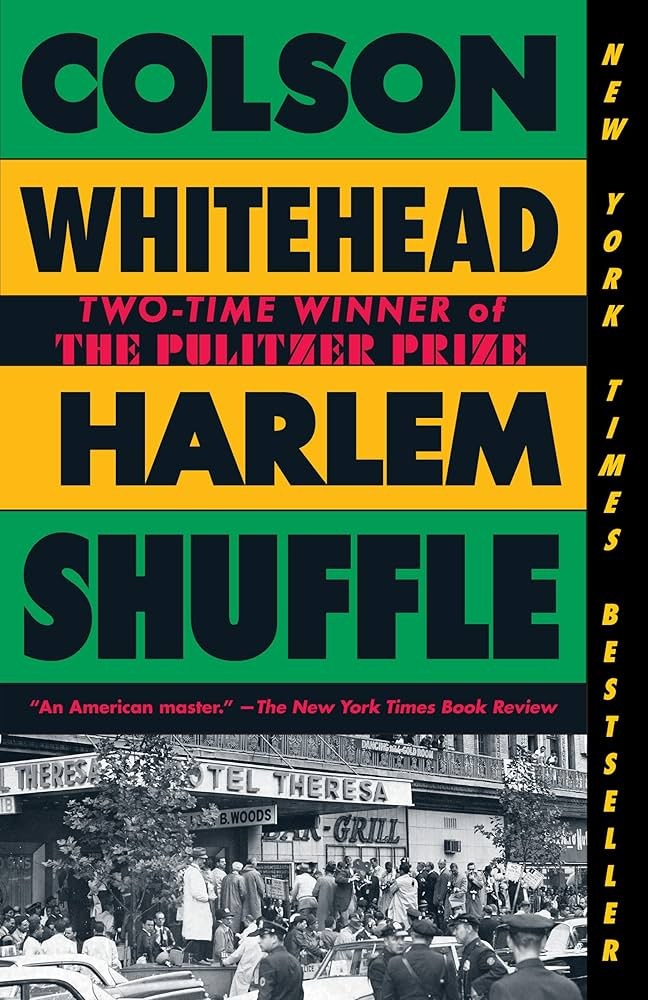
Harlem Shuffle by Colson Whitehead
Doing a Gemini search, this writer rose to the top as the best in new fiction. He’s a two-time winner of The Pulitzer Prize, and “An American master,” stated The New York Times Book Review. The front of the book is painted with rave reviews. A heavy hitter. As I understand it, Harlem Shuffle is the first book in a 3 book series. I’m very excited to dig—especially because it's a new voice. (Of course, he has written 11 books.)
First off, there are a lot of characters. Not just the people, but the place, Harlem, is a character in this work. It is beautifully written. You have to work hard to keep up. I think at this point in my journey, this book is over my head and my abilities as a reader. I found it hard to keep up.
First, it’s a history lesson in black culture in this period. Second, it's a love story about Harlem during this period of Americana. And then there are the people in this story. Everyone gets their history carved out, and he does a backstory on almost everyone introduced. Oh, and then there's the story. Somewhere, with all of these words, there’s a story going on. It leaks out, almost by mistake. I found this a lot of work to keep all of this in my head.
The book itself is broken into three time frames: 1959, 1961, and 1964. The main character, Ray Carney, is a compelling enough of a character, but it all gets washed out by all the other stuff going on in this book. Three books are going on, and focus seems to be the issue. I wanted to keep going, but found it too overwhelming. I guess I’m just ready for a book like this. To the boneyard.
Boneyard 9, No Recommendation 5, Recommend 5, Highly Recommend 3

The Big Bounce by Elmore Leonard
Elmore Leonard is big in my worldview of fiction writing. He’s known for his heavy dialogue-driven books. This is the style I have cultivated for myself. Before this little experiment of trying to become a reader, I’ve read more Elmore Leonard books than any other author. I found this book, The Big Bounce, at Half Price Books. It’s 4 x 6.75 in size and has 247 pages, so it’s small, almost a short story or novella. Half Price Books.
Elmore is famous for this one line: I leave out the parts that people skip. He must have cultivated this style later, because I wanted to skip—a lot—in this book. It starts big, with this guy Jack Ryan, no, not that Jack Ryan, this guy is a small-time crook, but he put a bat to a man's head, and it was all captured on film. For some reason, this doesn’t go any further legally, and we follow him around as he commits a small-time crime and then gets befriended by a man who puts him to work at his resort. Pick up garbage, rake sand, fix issues like leaky showers, and fix windows.
There’s lots of smoking and drinking and talking, or reflection on the past for most of the characters in the book. Jack emerges as a very different man from the one who hit a man in the head with a bat (that man who he hit, lived by the way). Very boring stuff, and about page 120, I was thinking this one's over for me, and there was this woman who is always in the background, popping up from time to time, hooks up with Jack, and they have a fun night throwing rocks through random people’s windows. Compelling (of course, I did keep reading).
She then lays out a plot to steal 55K, which at the time when this book was written, that was a good chunk of change. Finally, we’re getting somewhere, but then it goes back to smoking, drinking, talking about—stuff—with the plans to steal the 55k coming up every now and then, but that was it—to the boneyard. I started reading this book, and at one point, I was thinking why am I doing this? I took a break from reading, something I hadn’t done since I started this challenge to myself. But picked back up, read another 20 pages or so before I stopped.
So I did a little research on the book and Leonard’s career as a writer. This was his first book into crime. Before this, he wrote Westerns—so he cut his teeth in the crime genre with this book, so to speak. I don’t know if this is his SugarLand Express (Stephen Spielberg—did a movie with Goldie Hawn, that was a drama (her first drama), about a drug addict mother trying to travel to SugarLand, trying to get her kids back—it was awful, but it was also boring. He made a promise to himself, he would never create another movie that wasn't entertaining—and the rest, as they say, is history.) So maybe this was the same for Leonard? After this book, he pledged to himself that he would never write another book where people would want to skip parts. I have a history with his writing, which is why I didn’t, but if this were my first time reading his work, I would have definitely skipped and would never have picked up another book by him.
Side note: As I venture further down this road of being an author, I realize how useless reviews are. It’s the way books are marketed these days. Rarely do the reviews match what’s inside.
Boneyard 10, No Recommendation 5, Recommend 5, Highly Recommend 3

Famous by Blake Crouch
I’ve already stated how much I like this author. This book on his timeline is between Run and Dark Matter. Famous is about a guy who looks like a famous, award-winning actor. Once he gets fired from his job, he gets this great idea to impersonate the actor by going to New York. It works. The character's psychological makeup is revealed as the story unfolds—he really likes being famous, and he’s very disturbed (someone Blake makes him seem sympathetic to). This show finally moves on to LA. It’s a fun ride.
The writing in this book is very different. There are no short, fragmented sentences. This is a character study. It’s also a small work at 188 pages. I read it in a couple of sittings. I’ve sat with this one for a couple of days. I wasn’t sure what to do with it. The ending took me by surprise—not in a good way. But I thoroughly enjoyed ninety percent of the book. It's the ending.
In the current book I’m writing, I first wrote it as a short story for a college class—it was 32 pages. While writing it, it consumed my life. My other classes were suffering because I was hooked on writing the story. Finally, I just decided I had to end it. The professor gave me a B+, stating he felt the ending seemed forced. He was so right. And that's how I felt about this book. It came so fast, and it didn’t seem well-crafted—I was wondering if he just wanted to end it? And was he taking the easiest way out? I have to say it was jarring.
So I like ninety percent of the book, but is that enough to recommend it? I'm of the camp that if you don’t have an ending, you don’t have anything. I reluctantly give this one no recommendation.
Boneyard 10, No Recommendation 6, Recommend 5, Highly Recommend 3

Comments